
What is a scar? How a plastic surgeon approaches scar revision
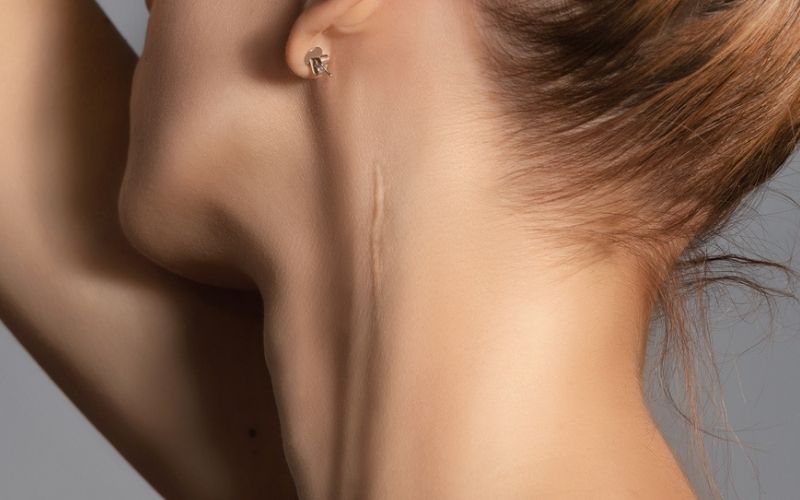
Leading London plastic and reconstructive surgeon Mr Juling Ong explains his approach to scarring and scar revision.
A scar is a mark left on the skin (or other tissue) after a wound, injury, or surgery has healed. It forms as part of the body’s natural healing process when the dermis (the deeper layer of the skin) is damaged. The body produces collagen fibres to repair the damage. The reason that scars look different from the surrounding skin is because of the way the collagen is organised.
The architecture of normal skin and scar tissue differs significantly in terms of structure, composition, and function. Here’s a breakdown of the key differences:
1. Normal Skin Architecture
Healthy skin is composed of three main layers:
- Epidermis (Outer layer): Provides a protective barrier and contains keratinocytes, melanocytes, and immune cells.
- Dermis (Middle layer): Contains collagen and elastin fibers, blood vessels, hair follicles, sebaceous (oil) glands, and nerve endings.
- Hypodermis (Subcutaneous tissue): Made of fat and connective tissue that insulates and cushions the body.
Key characteristics:
- Organised collagen fibers (woven in a basket-like pattern for flexibility).
- Elastin fibres (allow skin to stretch and snap back).
- Well-vascularised (good blood supply).
- Contains glands, nerves, and hair follicles.
2. Scar Tissue Architecture
When skin is injured, the body repairs it by forming a scar, but the replacement tissue lacks some of the normal skin’s properties.
Key differences:
- Disorganised collagen fibers – Instead of a flexible, basket-weave pattern, scar tissue has parallel bundles of collagen, making it stiffer.`
- Lacks elastin fibres – Scar tissue is less elastic than normal skin, which is why scars often feel tight or firm.
- Reduced blood vessels – This is why scars can appear pale or pinkish over time.
- No hair follicles, sweat glands, or sebaceous glands – This makes scars different in texture and function from normal skin.
- Thicker or thinner than surrounding skin – Some scars, like hypertrophic or keloid scars, are raised, while others, like atrophic scars, are sunken.
Functional implications:
- Scar tissue is less flexible than normal skin, which can lead to tightness, especially in large scars or contracture scars.
- Because it lacks sweat and oil glands, scarred skin can be drier and more sensitive.
- Nerve endings may not fully regenerate, so scars may feel numb or have altered sensation.
- There are also differences in the pigmentation of scars and they are usually more prone to sunburn.
How do I assess a scar?
Clinical assessment by examining the scar:
- Colour – Red, pink, brown, or pale compared to surrounding skin.
- Thickness/Elevation – Raised (hypertrophic or keloid) vs. flat or sunken (atrophic).
- Texture – Smooth, rough, or irregular.
- Elasticity – Stiffness or tightness in movement.
- Size – Length, width, and overall surface area.
- Vascularity – Presence of blood vessels (redness indicating high vascularity).
- Pigmentation – Hyperpigmentation (darker) or hypopigmentation (lighter).
- Adherence – How tightly the scar is attached to underlying tissue.
Scoring the scar by using a standardised scale:
Vancouver Scar Scale (VSS) is one of the most widely used tools for assessing burn and surgical scars. Evaluates four categories and scores range from 0 (normal skin) to a maximum of 13 (severe scar):
- Vascularity (0–3) → Degree of redness
- Pigmentation (0–2) → Hypopigmentation or hyperpigmentation
- Pliability (0–5) → Stiffness and flexibility
- Height (0–3) → Thickness of the scar
Understanding how the scar affects the patient in terms of restriction of movement as well as symptoms:
Some scars, especially burn scars or contracture scars, can limit movement or function. This is assessed by:
- Range of motion (ROM) testing – Determines mobility limitations.
- Pain and itch assessment – Using pain scales like the Visual Analog Scale (VAS).
- Quality of life (QoL) questionnaires – Tools like the Dermatology Life Quality Index (DLQI) assess the psychological and social impact of scars.
Patient self-assessment:
Since scars can impact a person’s confidence, comfort, and daily life, patient feedback is crucial. Self-assessment tools include:
- Visual Analog Scale (VAS) – Patients rate their satisfaction with their scar.
- POSAS Patient Scale – Asks about symptoms like pain, itching, tightness, and emotional impact.
- Quality of Life Questionnaires – Measures how much the scar affects daily life, work, and social interactions.
And there are objective measurement tools using different types of imaging and ultrasound as well as other devices which can evaluate the quality of the skin and the scar.
What are the different types of scars that you can get?
Types of scars:
- Flat and Faded Scars – Initially red or dark but fade over time.
- Hypertrophic Scars – Raised, thick, and red but remain within the original wound area.
- Keloid Scars – Overgrown, raised scars that extend beyond the wound site.
- Atrophic Scars – Sunken or depressed scars (e.g., acne scars).
- Contracture Scars – Tight, stretched scars often caused by burns.
Is it possible for a scar to disappear over time?
Scars may fade over time but usually do not completely disappear. Treatments like creams, laser therapy, or surgery can help improve their appearance. And although scars may never completely disappear they can become much less visible over time with the right treatment.
What can I do to improve the scar?
The first thing you should do is to see a plastic surgeon to get their professional assessment of the scar. They will help you understand what type of scar you have there are so many different factors that affect how a scar is going to evolve over the long-term.
Your surgeon will then also be able to explain the scar revision treatment options that you have to improve the quality of the scar to reduce the visibility of the scar over the long-term.
If you’re concerned about the appearance of a scar and want to discuss your options, call 020 7927 6528 or email info@julingong.com to arrange a scar revision consultation with Mr Juling Ong.


