
Upper blepharoplasty: what I do to achieve a natural rejuvenation
When patients look at upper eyelid before-and-after photos, the differences can seem subtle at first glance – yet the impact on eye openness, lash position, and overall freshness can be striking.
In this post, I’ll explain how I assess the upper eyelids and how I perform an upper blepharoplasty, also known as an upper eyelid lift.
The goal: brighter eyes that still look like you
Upper blepharoplasty is never about changing someone’s identity or creating an ‘overdone’ eyelid. I aim to:
- Reduce heaviness from excess skin
- Create a more youthful, fuller upper lid volume in the medial and lateral thirds
- Restore a cleaner eyelid shape with a defined full-length eyelid crease
- Improve eyelash position, curled upwards rather than downwards
- Maintain a natural brow height, lid contour and balance
- Where relevant, improve vision by removing skin that droops into the line of sight
What I assess before surgery
Every eyelid is different. A safe, natural result depends on diagnosing the cause of the eyelids looking heavy.
1) Brow position: the ‘frame’ above the eyelid
In many women, an attractive brow shape often has the outer (lateral) brow sitting just above the bony rim of the orbit. If the brow sits lower, it can push excess skin into the upper eyelid area, mimicking ‘lid excess’. When this occurs, removing skin from the lid may not improve its appearance.
In addition, brow shape matters: ideally, the brow has a gentle curve, with its highest point (the peak) around the junction between the inner two-thirds and the outer one-third—usually roughly in line with the outer corner of the eye (the lateral canthus).
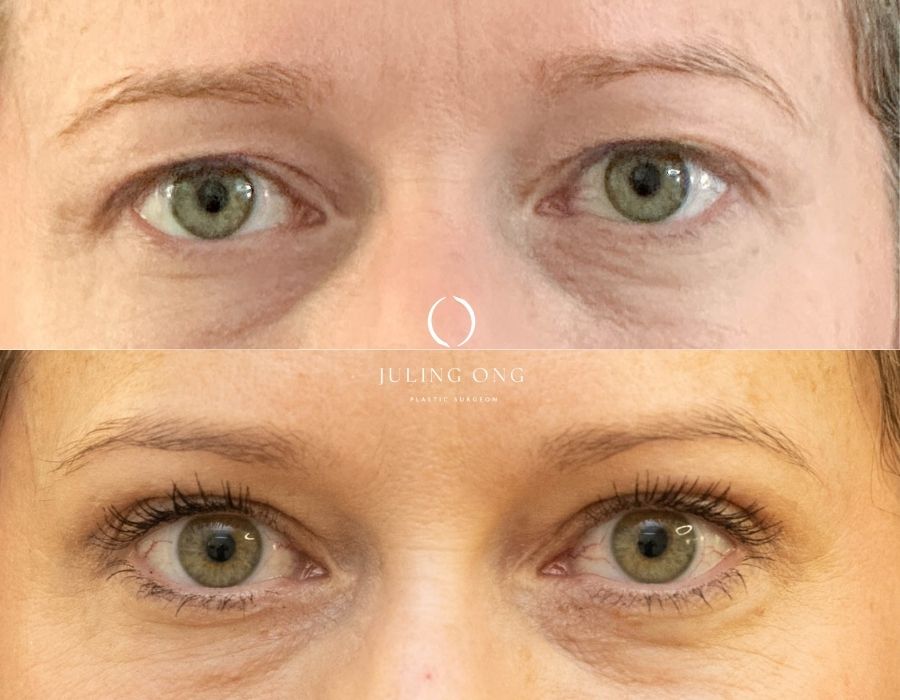
In this patient, the brow position has a small influence on eyelid heaviness – especially laterally. She wanted a natural brow, not a high ‘Botox brow’. As you can see, the brow is flat in the medial 2/3 and slopes gently downwards in the lateral third.
So in this case, I recommended Botox before surgery to:
- gently lift the peak of the brow and stabilise the brow position in a natural, youthful position, which was the optimal aesthetic position for her
- resist the brow dropping further after skin removal
- ensure we were correcting the eyelid itself when the surrounding tissues are in the correct position
Some patients need a surgical brow lift instead; many like this patient don’t. The key is choosing the right procedure to help the patient achieve their individual goals.
2) Eyelid crease height (medial and lateral)
The eyelid crease is a major aesthetic landmark. I assess:
- the height and shape of the crease
- asymmetries
- how much of the ‘tarsal platform’ (the visible eyelid skin below the crease) is showing
This helps plan incision placement and predict what changes will look natural.
3) Skin excess: aesthetic vs functional needs
I perform a pinch test with the patient:
- Seated (maximum): shows the maximum amount of skin that could be removed cosmetically, and this is often done in the clinic as well as on the day of surgery.
- Lying down (minimum): confirms how much skin can be removed safely, without significant compromise to eye closure or risk of excessive dryness.
A reliable indicator that the skin tension is ‘just right’ is a slight upward curl of the lashes at the end of surgery – without forcing the lid open and without creating a hollowed appearance. In practice, this is often between aesthetic and functional measures. The patient’s individual characteristics and pre-existing morbidities need to be considered when determining the amount of lagophthalmos (or gapping between the eyelids) that each patient can tolerate.
4) Eye health and lifestyle factors (this matters more than most people realise)
We discuss:
- baseline dry eye symptoms
- any eye conditions
- vision
- previous eye surgery
- contact lens use
- whether vision is obstructed by the lid skin (especially with reading or driving)
- occupational factors (functional – such as driving, to cosmetic – such as client or public-facing jobs)
This guides how conservative we need to be and how we counsel patients in the peri-operative recovery.
The surgical plan: where the incisions go
Upper blepharoplasty incisions are planned to be hidden in the natural eyelid crease.

Lower incision: placed in the crease
In a typical Caucasian patient, the crease typically sits 6–10 mm above the lash line (this varies by anatomy and ethnicity). I measure this gently with the lid under light stretch and observe where the skin naturally folds when it moves. I can also confirm the tarsal height by flipping the lid over and measuring it with callipers. There is occasionally an asymmetry; if it is minimal, it can be accepted to preserve the natural skin crease.
Upper incision: determined by safe skin removal
This depends on the pinch test and brow-to-lid distance.
Medial and lateral limits (important for natural blending)
- Medially: I generally limit the length of the incision to the region near the punctum (the inner corner tear drainage opening). If there’s a small amount of excess skin, also known as a ‘dog ear’, I will design a subtle extension angled upward and medially toward the glabella to remove this excess skin and achieve a smooth, flat medial contour.
- Laterally: At the lateral canthus, I will angle the incision upwards along the line of a natural skin crease towards the lateral brow. This allows me to remove a bit more skin at this point, which helps to achieve a bit more tarsal platform show as well as curling the lashes up more in the lateral third.
This is one of the details that helps the eyelid look more beautiful, youthful and refined rather than ‘operated’.
What I do during the procedure (and why)
1) Skin excision: removing the excess skin drape without over-tightening
The most visible difference in ‘after’ photos is usually that:
- the eyelid skin no longer folds onto the lashes
- the eye lashes becomes more visible
- the entire lid crease is visible from medial to lateral, which makes the eyes look more open and less tired
Ideally, skin removal also allows the lashes to roll slightly upwards, highlighting them against the paler skin of the upper eyelid.
From an aesthetic perspective, my goal is a smooth, natural fullness or convexity above the incision—especially laterally, which transitions to a flat or subtle concavity at the medial eyelid.
2) Muscle management: tailored, conservative
The eyelid muscle (orbicularis) contributes to:
- eyelid fullness
- blinking and eye closure
In selected patients, a small amount (up to 50%) of muscle can be removed to decrease heaviness. However, I’m cautious: removing too much can risk a weaker blink and dryness.
3) Fat: preserve what you need, remove what you don’t
The upper eyelid contains fat pads, which are really important in the overall shape of the upper eyelid.
Medial fat pad (inner corner fullness)
This is often the part patients describe as a ‘puffy inner corner’. If it’s prominent and causing a discrete focal bulge medially, I will remove a small amount – carefully – as it is close to the superior oblique muscle, which helps move the eye. It can also be mobilised or transposed to the medial third of the eye to help address excessive hollowing, a feature of ageing. This intra-orbital fat pad often becomes more prominent with ageing.
A key principle: the medial area should look smooth and flat, not hollow and not bulging. If there is excess skin medial to the punctum, I may remove skin there after addressing the medial fat, so the inner contour remains natural. This bulge is addressed primarily by fat removal, but may also require skin removal if it remains lax and excessive.
Central pre-aponeurotic fat (the ‘supporting fullness’)
This central fat often helps keep the eyelid looking youthful. I generally prefer to preserve it, and in some patients, I gently mobilise it from lateral to medial to soften a central hollow or to treat or prevent the classic “A-frame” hollowing. This fat pad often atrophies with age, resulting in a hollow appearance to the eye socket and upper lid.
Lacrimal gland (outer upper lid fullness)
Sometimes, the lacrimal gland (tear gland) can slip down from its position behind the orbital rim and project into the eyelid or appear prominent. This can:
- add bulk to the outer third of the lid
- reduce visible crease definition
- reduce the visible ‘tarsal platform’ (that clean lid space people often want)
If this is contributing, it needs to be recognised and managed appropriately – otherwise, a simple skin excision won’t fully address lateral heaviness. In my practice, I usually reposition this under the lateral orbital bone with a couple of tiny sutures
4) Brow fat suspension sutures (when appropriate)
In many patients, I will use supportive sutures to:
- improve the subbrow contour in the lateral third of the eye
- increase visibility of the tarsal platform
- define the transition between brow and lid
This can subtly improve the ‘frame’ of the eye without changing the patient into a different person.
So what changes in the ‘after’ photo?
In my patient, the typical visible differences are:
- The upper lid skin no longer rests on the lashes
- A cleaner, full-length eyelid crease
- More visible tarsal platform of about 2mm (without overexposure)
- A smoother inner corner (less medial puffiness)
- A gentle lateral lift in the eyelash angle and slightly wider tarsal platform
- A brow that looks stable and natural, not artificially high
- The impression of a slightly more upturned lateral canthus is created by removing the overhanging fold of skin from the upper lid
- A fresher, more youthful appearance with the eyes still looking unmistakably like her
- A super, natural appearance without any visible signs of surgery, even on close inspection
What patients usually ask next
Will it look natural? That’s my goal. The operation should make you look rested, not ‘done’.
Is it just skin removal? Not always. Skin is part of it, but brow position, incision placement, skin and muscle resection, fat distribution, and lacrimal gland position often matter just as much.
Will it help vision? If skin is encroaching on your visual field, it often does. We can discuss this during the assessment.
If you’re considering upper blepharoplasty
A good consultation is half the operation. The safest and most natural results come from careful assessment, conservative planning, and an approach that preserves youthful structure while removing what’s truly excessive.
To book a consultation with Mr Juling Ong, call 020 7927 6528 or email info@julingong.com.


